
Your Child May Not Know They Can't See Properly. You Need To.
Children cannot tell you their vision is blurred — because they have nothing to compare it to. They assume everyone sees the way they do. Early eye examination is the only way to detect problems before they permanently affect your child's vision, learning, and development.
Signs Your Child May Have an Eye Problem
Children rarely complain about vision. Watch for these instead.
Moving close to see better — a classic sign of myopia (short-sightedness)
Squinting narrows the field of vision and temporarily improves focus — an effort to compensate
Can indicate eye strain, allergy, blocked tear duct or a turned eye working too hard
Squint (strabismus) — needs prompt assessment. Does not resolve on its own.
Many children labelled as inattentive or slow simply cannot see the board or page clearly
Important: A child with a lazy eye or squint will not volunteer this information. The brain simply suppresses the weaker eye. Only examination reveals it.
Why Paediatric Eye Care Requires a Specialist Approach
Children's eyes are not just smaller adult eyes. They are still developing — and that development window is both an opportunity and a risk.
The Visual System Is Still Developing
The brain's ability to process visual information develops rapidly from birth until approximately age 8. Problems in this window — if untreated — can cause permanent changes to the visual pathways that cannot be reversed later.
Children Cannot Describe What They See
Young children have no reference for normal vision. They cannot tell you their vision is blurred because they do not know what clear vision feels like. Examination is the only way to find out.
The Treatment Window Is Limited
Amblyopia (lazy eye) can be treated effectively up to about age 7–8. After this, the visual cortex matures and treatment becomes much less effective. Early detection allows treatment during the window of opportunity.
Measurements Require Special Techniques
Testing a child's refraction requires cycloplegic drops to relax the focusing muscles — without them, children unconsciously accommodate (focus) and give inaccurate results. This technique requires experience.
Cooperation Requires a Child-Friendly Approach
Successful examination of a young or uncooperative child requires patience, child-friendly techniques, and the ability to adapt the examination to the child's age and temperament.
Vision Affects Learning and Development
80% of classroom learning is visual. Poor uncorrected vision affects reading, writing, sport, and social confidence — often before anyone realises vision is the cause.
How Children's Vision Develops — and Why Each Stage Matters
Paediatric Eye Conditions Managed at Sobti Nursing Home
Dr. Amit Sobti has AIIMS training in the full range of paediatric eye conditions — from simple refractive errors to complex surgical cases.
Refractive Errors — Myopia, Hyperopia, Astigmatism
Short-sightedness, long-sightedness, and cylindrical power are the most common childhood eye problems. Corrected with glasses or contact lenses. Early correction is essential to allow normal visual development.
Amblyopia (Lazy Eye)
One eye develops weaker vision because the brain favours the other. No pain, no redness — completely invisible without examination. Treated with glasses and patching. Must be treated before age 8 for full effect.
Squint (Strabismus)
Misalignment of the eyes — one turns in, out, up, or down. Does not resolve on its own. Causes amblyopia if untreated. Treatment involves glasses, patching, and often surgery.
Blocked Tear Duct (Dacryostenosis)
Very common in newborns — one or both eyes water excessively with sticky discharge. Most resolve by 12 months with massage. Persistent cases require a simple probing procedure.
Allergic Conjunctivitis
Itchy, red, watery eyes — often seasonal or related to dust, pets, or pollen. Very common in children. Effectively managed with appropriate antiallergic eye drops and avoidance advice.
Infective Conjunctivitis (Pink Eye)
Bacterial or viral eye infection causing redness, discharge, and irritation. Common in school-age children. Treatment depends on the type — bacterial needs antibiotic drops; viral is self-limiting.
Congenital Cataract
A cloudy lens present from birth or developing in early childhood. Rare but serious — requires prompt surgery to prevent permanent amblyopia. Early identification is critical.
Ptosis (Droopy Eyelid)
A drooping upper eyelid that partially covers the pupil. Can cause amblyopia by blocking the visual axis. May require surgery to lift the lid and allow normal visual development.
Myopia Progression Management
Children's myopia can progress rapidly year on year. We monitor progression carefully and can discuss strategies to slow it — including specialised lenses and lifestyle advice.
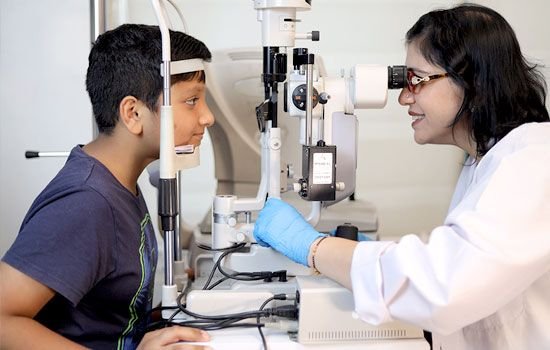
What Happens During Your Child's Eye Examination
The examination is gentle, painless, and adapted to your child's age. Dr. Sobti is experienced with children of all ages — including infants and uncooperative toddlers. No test requires the child to read letters or give verbal responses in the earliest age groups.
Dr. Sobti will ask about your concerns, birth history, family eye history, and observe how your child uses their eyes naturally during the consultation.
Age-appropriate vision testing — picture charts for young children, letter charts for older ones. Each eye tested separately to detect differences between the two.
Drops are instilled to dilate the pupils and relax the focusing muscles. After 30–45 minutes, the true refractive error of each eye is measured accurately. Eyes remain dilated for a few hours — bring sunglasses.
The anterior segment and retina are examined with a slit lamp and ophthalmoscope. The optic nerve, macula, and retinal periphery are assessed.
Dr. Sobti explains findings clearly in language parents can understand, provides a written prescription if glasses are needed, and outlines the treatment plan step by step.
Recommended Eye Screening Ages for Children
These are general guidelines. Any concern at any age is reason enough to book an appointment — don't wait for a scheduled milestone.
First Screening
If there is a family history of squint, amblyopia, or high refractive error — or if parents notice any eye turn or asymmetry.
Pre-School Check
Recommended for all children regardless of family history. The critical amblyopia treatment window is open — detection here allows maximum benefit from treatment.
Before School Starts
Essential before starting formal education. Undetected vision problems directly affect reading and writing ability from day one of school.
School-Age Onwards
Myopia commonly develops and progresses between ages 6–18. Annual or biannual checks ensure glasses prescriptions are current and progression is monitored.
Don't wait for a milestone if you have a concern. If your child is squinting, sitting close to screens, complaining of headaches, or performing poorly at school — come in now. A paediatric eye examination takes less than an hour and could make a significant difference to your child's future.
Paediatric Eye Care by an AIIMS-Trained Specialist
Children deserve specialist care — not a general eye check adapted for small patients. Dr. Amit Sobti's AIIMS training covers the full range of paediatric ophthalmology, from amblyopia management to squint surgery in infants.
Paediatric ophthalmology is a core part of the AIIMS ophthalmology curriculum — including amblyopia, squint, and congenital eye conditions.
From newborn screening to teenager myopia management. Techniques are adapted to each child's age, temperament, and cooperation level.
Children are not small adults — they need a different approach. Dr. Sobti takes the time to make every child comfortable before beginning any examination.
Many centres skip or rush cycloplegic drops to save time. We never do. An accurate prescription for a child's eye requires dilated refraction — it is non-negotiable.
Paediatric Eye Care — Common Questions
Give Your Child the Gift of Clear Vision
A paediatric eye examination at Sobti Nursing Home is gentle, painless, and could protect your child's vision for life. Book today.